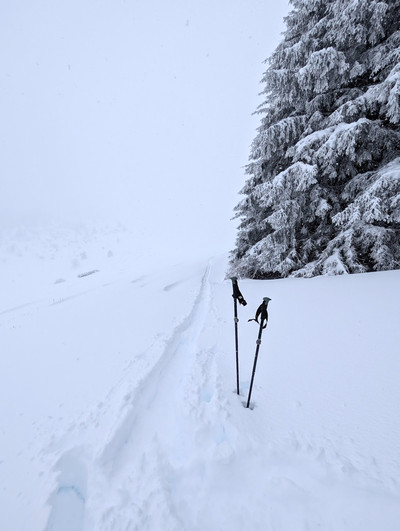
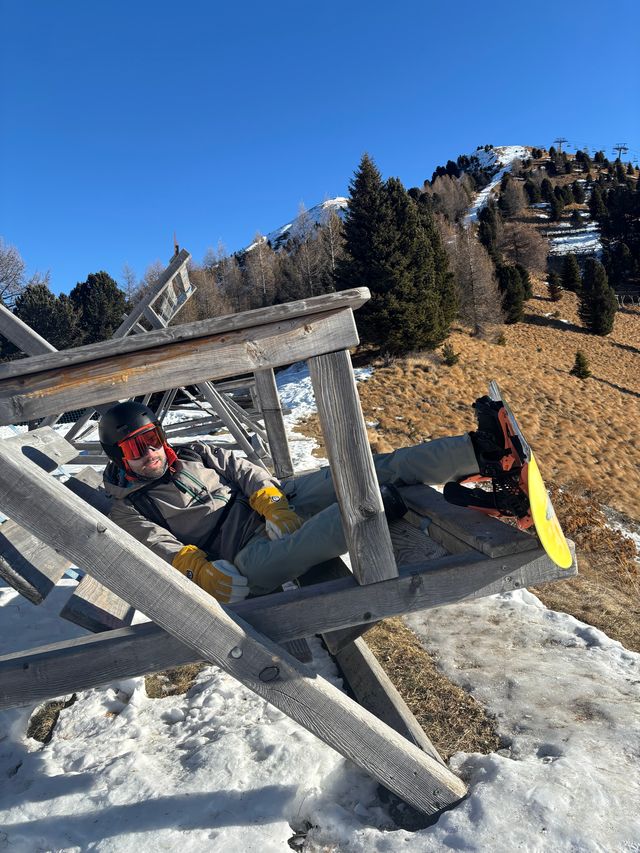
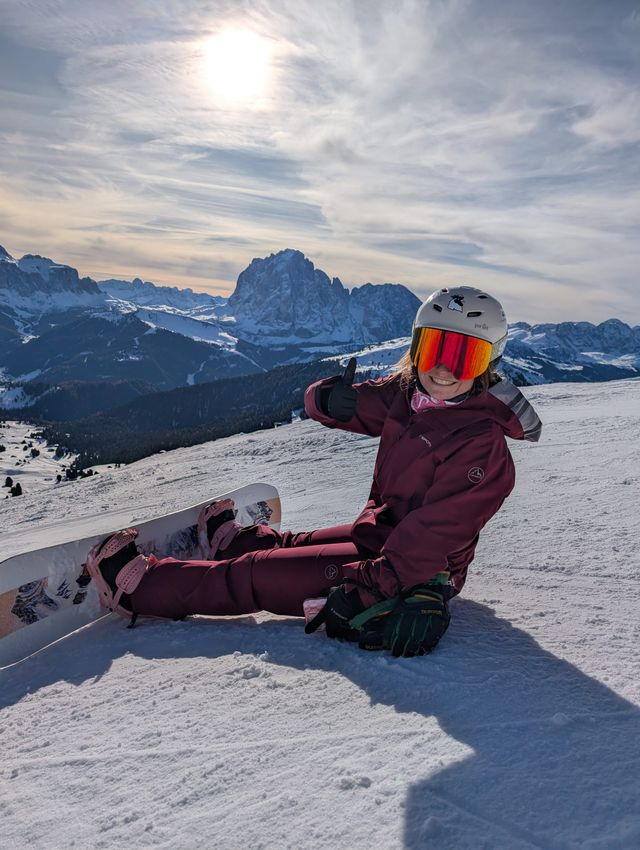
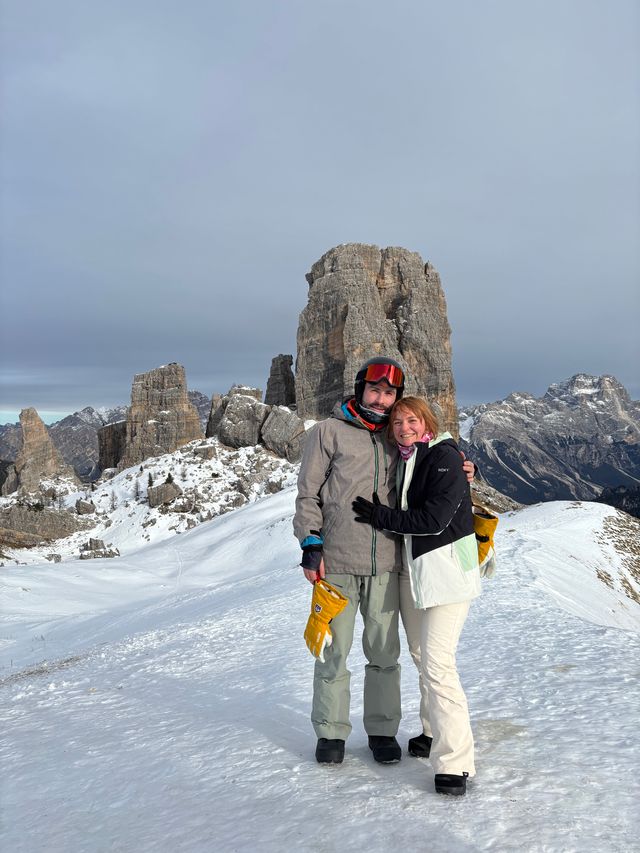
If that feels overwhelming, don't worry — we're here to help.
We've compiled this simple digestible guide to help you plan an epic winter adventure one step at a time.
Pick your base.
Follow the routes.
Skip the guesswork.
Start your journey here.
Don't worry, this is not yet another AI generated filler designed to waste your precious time.
We're two very real humans (and a small cat) living in Northern Italy. We spend the winter moving through the Dolomites, chasing conditions and learning the details that don't show up on maps.
Often, we find ourselves at the classic "I wish somebody told me that..." moment right after we do something (not so) obviously dumb.
Where to park when it’s busy. Which rifugios need a booking — and which ones don’t. Which valleys stay sunny, which hold cold snow, and where to go for steep, serious runs.
This guide aims to be that somebody. It's our experience, distilled and organized. Use it to plan faster, make better calls on the day, and put your time and energy into skiing.
Go step by step — or jump straight to the shortcuts if you already know what you want. But first, let us show you that it's worth all the hype.
Dolomites 101: What and Where Are the Dolomites
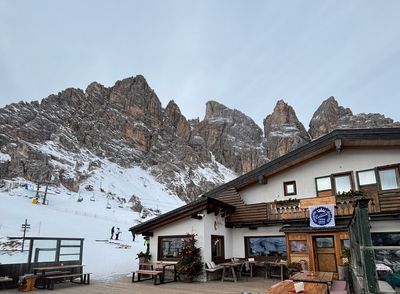
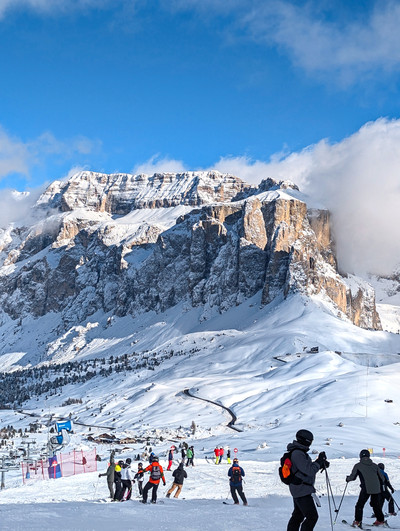
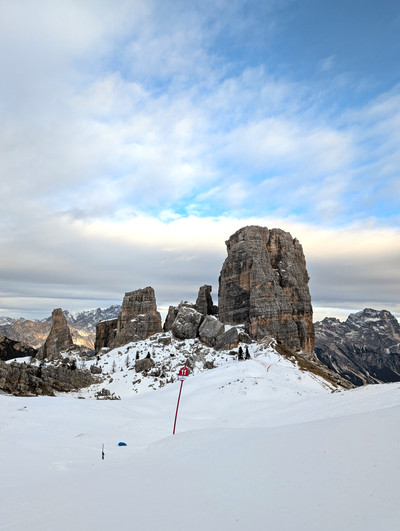
The Italian Dolomites are a beautiful mountain range that stretches on both sides of the Adige Valley in Northern Italy with the most famous peaks located on the east side. Composed of dolomite limestone, they are known for dramatic jagged peaks shooting straight up from the meadows above the deep valleys.
They might not get the most snow on the planet, but what they lack in snowfall they more than make up for in blue-sky sunny days and gorgeous views.
And the best part? They are very very skiable. Get to the top of the highest peak - Marmolada (3,342m) and enjoy the ridiculously long (12km) run all the way down or hop on the endless (40km) Sella Ronda ski circuit. You can ski them all.
The Ski Resorts of the Dolomites
Now that we've hopefully got you excited, let's look at the ski resorts of the Dolomites.
From the very top level, the Dolomites are split into two main ski pass networks: Dolomiti Superski and Skirama Dolomiti.
The larger and more famous of the two networks, covering 12 major ski areas across the Dolomites. Mostly on the east of the Adige Valley and the A22 highway. Includes iconic destinations like Seceda, Marmolada, Sella Ronda, Cortina, and Arabba.
12 ski areas
450+ lifts
1,200+ km of runs
Single pass access
TLDR; #1
Now that you know the Dolomites basics, maybe you're ready to pull the trigger and book your trip. Here are a few scenarios that could help.
I want to ski in the spots I see on Instagram.
→ Dolomiti Superski; Pick a base in one of the towns of Val di Fassa, Val Gardena, or Val Badia. These are all connected to the Sella Ronda circuit and offer access to the iconic peaks like Seceda, Marmolada, and Sassolungo.
I want to ski the 2026 Winter Olympics venues.
→ Dolomiti Superski; Cortina d'Ampezzo. Stay in Cortina and ski the women's downhill course at the Tofana ski area and see if you have what it takes to be an Olympian.
I am coming for one week and I want to have access to as much terrain as I can.
→ Dolomiti Superski; Sella Ronda. Cover the area from any of the three connected valleys: Val di Fassa, Val Gardena, or Val Badia.
I want to ski the famous ski circuits.
→ Dolomiti Superski; Val Badia. Stay in Val Badia with direct access to the Sella Ronda circuit and also to Cortina's Super 8 circuit from Armentarola.
Our Experience
Stories from the Slopes
Read about our actual ski days in the Dolomites—where we went, what we learned, and the moments that made each day special.
Pozza-Buffaure: Our Favorite Ski Area in Val di Fassa
Pozza-Buffaure: Our Favorite Ski Area in Val di Fassa
In general the season starts in early December and goes till April. To some extent it depends on the snowmaking and the weather conditions. There might be some areas or even just single lifts that will start earlier and some might stay open later. But you never know. The best is to check the live info before booking your trip.
If you end up in the shoulder season, for example for backcountry skiing, just know that it's not only the lifts that are closed. The mountain towns will likely be half dead with significantly fewer options for dining and accommodation. And on the mountain, many of the huts will be closed as well, since the summer season up there typically ends in late September/early October and the winter season starts only in December too.
The snow is never guaranteed, but YES, it is very likely there will be snow if the ski areas are open.
We all love some fresh powder, but truth be told, the way we're treating the planet, we can't really expect it to keep providing the white gold like clockwork anymore. The good news is that the snowmaking technology has significantly improved and so, granted it is cold enough, the runs will be covered in decent artificial snow. And we're not talking the ice luge as it was 10 years ago. These days, the fake snow is actually pretty good and it lends itself to great carving.
For the lovers of sunny bluebird days, that might be even better than the low-visibility powder days.
Again, to be safe, check the resort website for live updates or use one of the many snow forecasting services. Our favorite is
snow-forecast.com
.
Will It Be Crowded?
The Dolomites are a hot commodity right now, especially after the Winter Olympics in Cortina. So obviously, there will be some crowds on some days, but not as bad as you might think. So far we've always been able to find a quiet spot in one of the ski areas to enjoy some peaceful skiing. Some days we even had entire slopes to ourselves. You just have to be smart about it and plan your day accordingly. Here is some wisdom we've collected over time:
Major holidays like Christmas, New Year's, and long weekends are going to be busy. We all like to ski and there's nothing that can be done about it. If you hate people, just avoid these days.
Weekends are always busier than the weekdays since all the ski areas are within driving distance of major cities. And why would you not go skiing if you lived just a few hours away?
The first sunny day after a few days of bad weather will be crazy. All the pent up energy of all the bluebird-only skiers will be unleashed and the slopes will be packed. Plan to visit smaller, or less famous ski areas on these days.
The central and most connected ski areas are going to be the busiest. If you want to avoid the crowds, the gateway ski areas and towns at the ends of the valleys are your best bet.
Cable cars are the bottleneck. They only go so often, so they get backed up, especially if they are the only access point to the mountain. If you can, aim for gondolas and chairlifts over cable cars.
School holidays are always busy. You can't just pull the kids out of school to bag some powder turns whenever you want these days. People naturally cluster their trips around the school holidays. Check when the usual suspects like Germany, Netherlands, Poland, and the Czech Republic (countries who love to ski but have no good mountains) have their winter school breaks and try to avoid these if you can.
Go against the flow. Go a bit earlier if you want to have parking guaranteed. Lap a few good runs around the edges of the ski areas while the crowds are migrating. Don't chase good skiing and seeing places at the same time; it usually ends up with waiting in massive lines and getting neither. Plan your return trip earlier than 4pm and enjoy some late-day laps in your base area while everyone else is queuing for the last lift over the pass.
If you're planning on taking the ski bus, it might be a good idea to stay close to the edge of the town. The central stops can get really crowded, so it might be worth spending 10 extra minutes commuting over not getting on the bus at all.
TLDR; #2
Short version of everything above about timing your trip.
What is the typical winter season?
Early December through April, with some areas or individual lifts opening a bit earlier or staying open a bit later depending on snow and temperatures.
Will there be snow?
Yes — if the lifts are spinning, there will be snow. Either it dumps naturally, or the snowmaking systems will do the heavy lifting and keep the runs covered.
Will it be crowded?
It can be, especially on classic busy days, but the Dolomites spread people out well across huge networks of lifts and runs. Pick your area and timing right and you can still find quiet slopes.
Which dates to avoid?
Major holidays (Christmas, New Year's, long weekends) and the main school break periods for Alpine-loving countries like Germany, the Netherlands, Poland, and the Czech Republic.
Not sure yet? Read on.
How Do the Ski Passes Work?
There are two dimensions to this question so let's look at them one by one.
Which part of the Dolomites do you want to ski?
This mostly comes down to two things: where you base yourself and how much terrain you can realistically cover each day. Even strong skiers can only go so far once you include traverses, lift lines, and the mandatory coffee-and-beer breaks.
A simple rule works well: start with the most local pass and only go broader if you need to. Broader passes include the smaller ones, so you can think of them like nested levels.
Example: Buffaure in Pozza di Fassa . Buffaure-Ciampac stretches between Pozza and Alba and connects into Belvedere, Sella Ronda, Marmolada, and beyond. Here is the pass ladder:
Local pass: Buffaure-Ciampac
Best if you are only skiing Buffaure-Ciampac. You will also usually find extra-local beginner options for selected lifts.
Buy online at buffaure.it or at the base ticket offices in Pozza and Alba.
Valley pass: Val di Fassa/Carezza
Good for skiing across the wider Val di Fassa valley while keeping your base near Buffaure.
Buy online at fassa.com or at ticket offices in the included ski areas.
Regional upgrade: Valle Silver
Adds more range, including Val di Fiemme, Passo Rolle, and San Martino di Castrozza.
Note: These less common passes are sometimes surprisingly hard to find. For this one specifically, you can find it by clicking through the Superski pass, selecting "Val di Fassa/Carezza", choosing 5 or 6 consecutive days, then clicking "Valle Silver" under Other Options at the bottom of the page—phew. Alternatively, you can always email the respective ticket office; in our experience they are very helpful and respond fast.
Full network: Dolomiti Superski
Best if you want maximum flexibility across all major Dolomites ski areas.
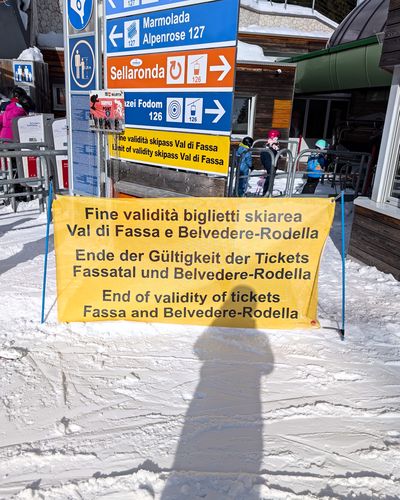
Don't worry, there are usually signs warning you when you're about to cross into a different ski area.
Time
The second part of this question is about how long you are staying. Exact pricing depends on your dates and ski area, so you will still need to click through the official pass tools. But these rules of thumb are a good starting point:
Early bird gets the discounted worm. This applies to both local day passes and season passes. For example, many day tickets are cheaper if bought at least two days in advance, and Dolomiti Superski season prices increase after the early window.
Expect seasonal price bands: Promo, Normal, and High. Promo is usually early and late season, High season is commonly Christmas/New Year and mid-February to mid-March, and Normal covers the rest.
Book online whenever possible. Prices are often lower, and pickup at resort vending machines is usually faster than waiting in the main ticket-office lines. The future is now.
At least in Dolomiti Superski, the pricing logic is usually fair: it is designed so longer durations do not accidentally cost more than a better-value pass tier (for example, season pass vs. many consecutive days).
With these in mind, there are a few no-brainer scenarios:
Week-long trip, skiing every day
Buy the number of days you need for the area you are skiing. Book online and at least a few days in advance for the discount.
Local or frequent visitor, skiing the whole season
The 25/26 break-even was around 18 days. If you are sure you will ski more than that, get the season pass before Christmas and you are set for the winter.
Same as above, but unsure how many days — want to avoid buying each time
Get the Dolomiti SkiMyWay pass: link your card and you are charged by where and when you ski. Half day, full day, one area or Superski — it adjusts. The only time you lose out is if you end up skiing more than the break-even days; then a season pass would have been cheaper.
SkiMyWay feels too much; you will ski a fair number of days but not the whole season
Consider the Superdays pass — a bundle of 10 days to use anytime during the season, not necessarily in a row.
Short trip, light skiing — a few runs then hut time
Consider a points pass: you get a set number of points and use them across any area; each lift deducts a set number from your balance.
Hopefully this brings some clarity to which ski pass to buy. For completeness, here is a quick comparison table based on 25/26 prices. Prices are for one adult in high season (where applicable), with no discounts - basically as expensive as it gets.
If this still does not clear things up, contact us and we can help.