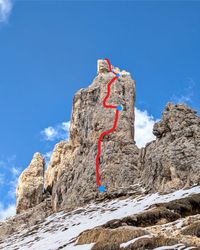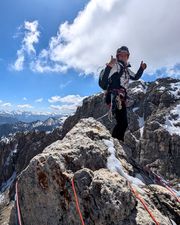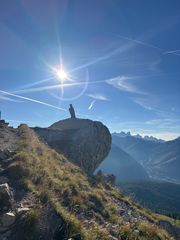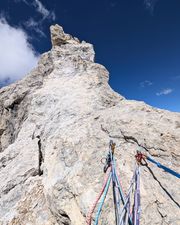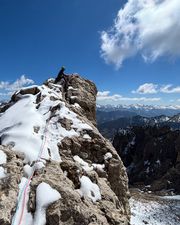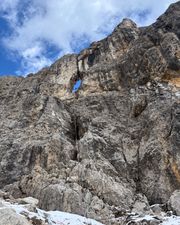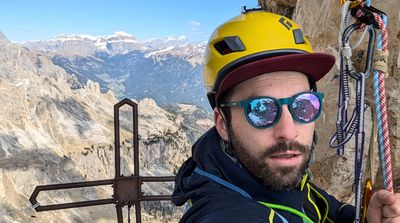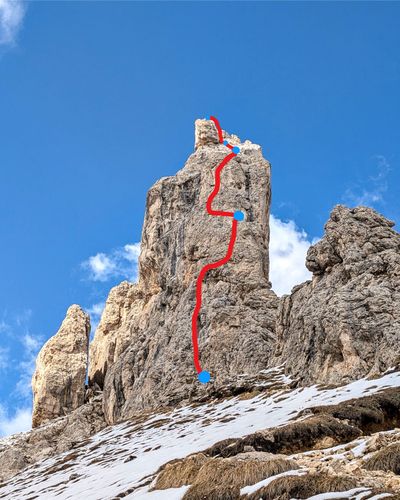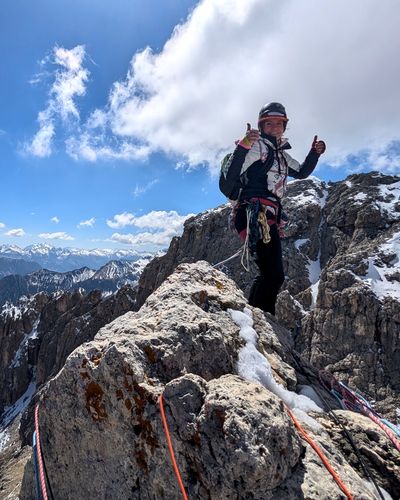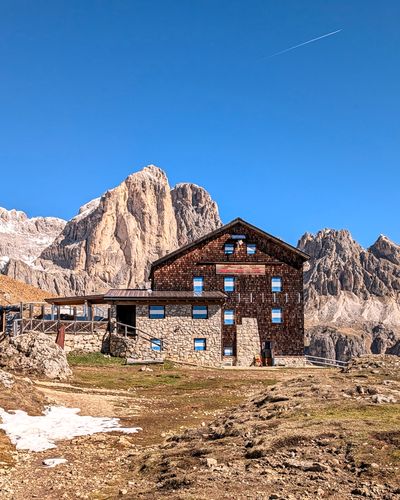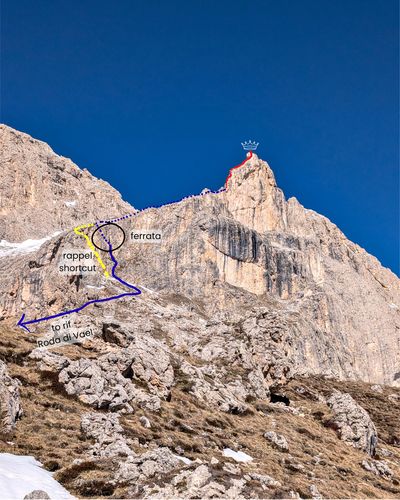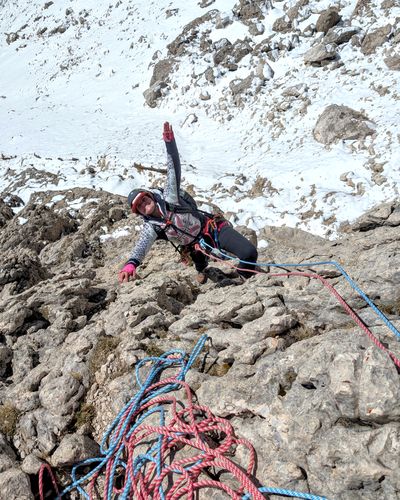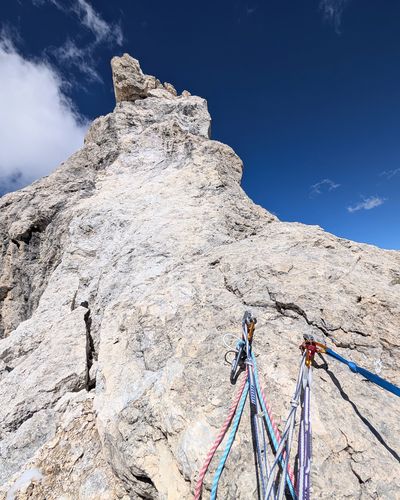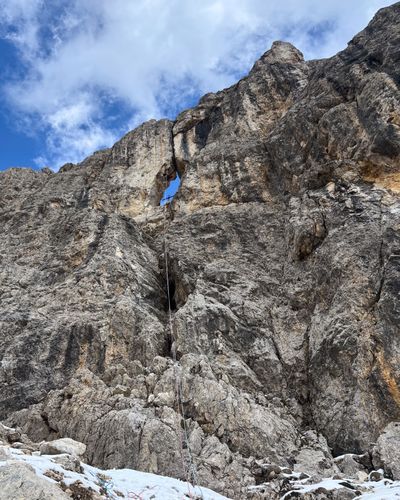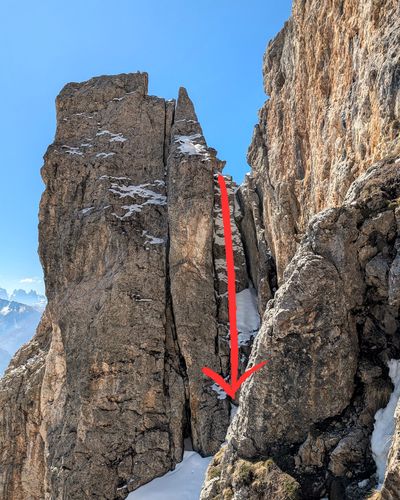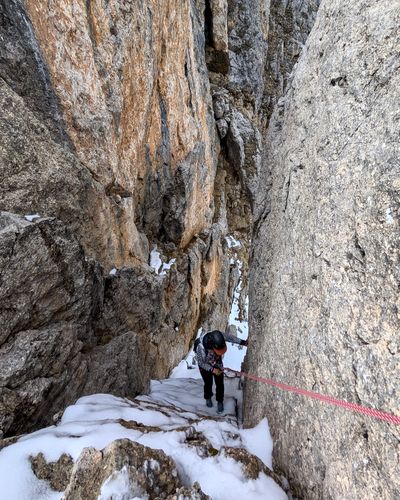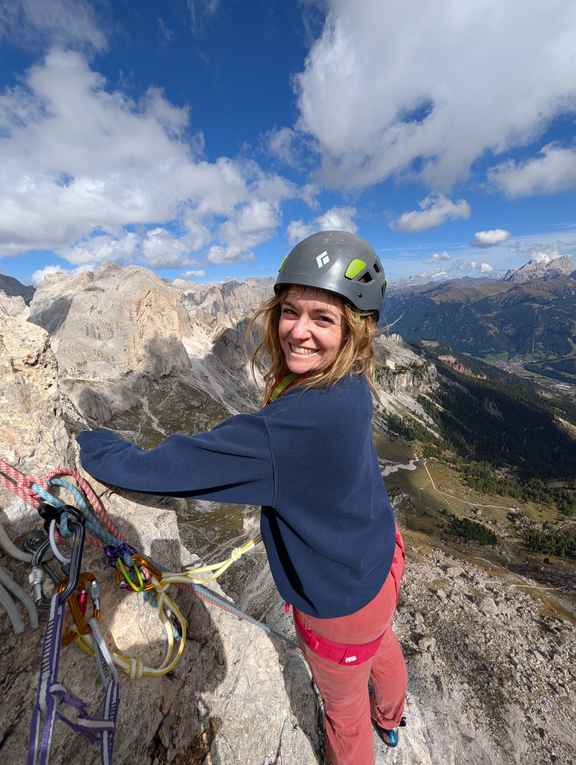
Via Spigolo Sud is a classic, easy, and not too long route in the Catinaccio group just above Rifugio Roda di Vael. It follows the south ridge and in 3 or 4 pleasant pitches, it takes you to the top of Torre Finestra.
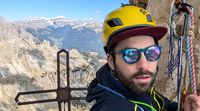
The first two pitches have some fun vertical climbing on good holds, the two upper pitches are more of a scenic slab tour. The whole route is easy to navigate as you can often see the anchor already from the bottom. The time commitment is not crazy either. It can easily be done under 2 hours. As a bonus, you get to rappel over the window with the cross which makes for a sick view into the valley below.
It’s a great little route for many occasions. It can be your first route early in the season, when the weather can still turn unpredictably. It makes for a great entry route for breaking the alpine trad climbing. Or you can probably even do it with kids.
Parking & Approach
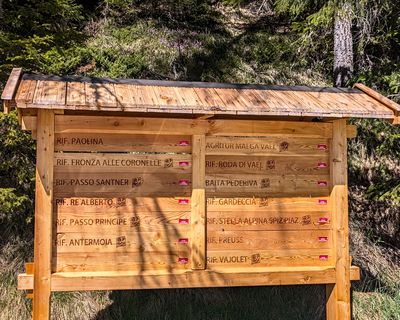
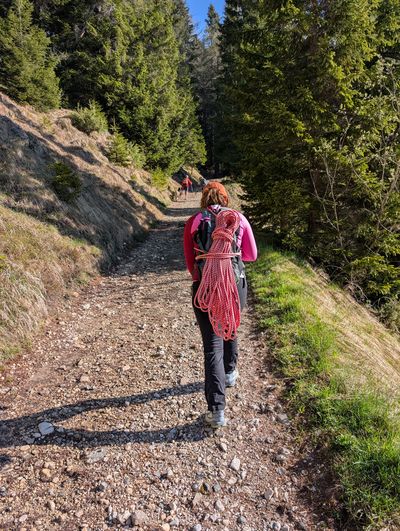
To get to the route you first have to get to Rifugio Roda di Vael . The Catinaccio group has a dense network of trails so there are many ways to reach the refugio. Our favorite approach is from Passo Carezza/Karerpass .
Getting to Rifugio Roda di Vael
From Carezza, there are 3 alternative routes to choose from:
- 2 km 160 m 40 min 26 Paolina parking - Paolina Chairlift - Rif Paolina - Trail 539 - Trail 549 - Rif Roda di Vael
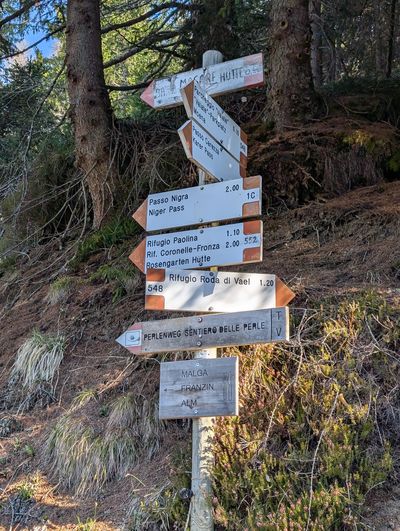
- 3.8 km 520 m 1h 30 min Costalunga parking - Trail 548 - Trail 552 - Rif Paolina - Trail 539 - Trail 549 - Rif Roda di Vael
- 3.5 km 520 m 1h 30 min Costalunga parking - Trail 548 - Rif Roda di Vael
The Easy Way
The first option involves the chairlift, which is only open from May 30th through October 11th between 8:15 and 17:45. The chairlift saves you about 500 m of elevation and cuts the approach down to 40 minutes. But for the 2026 season, the round-trip ticket is a whopping 26 EUR. It ends by Rifugio Paolina. From there, follow Trail 539, which merges with Trail 549, and in about 40 minutes you arrive at Rifugio Roda di Vael.
If you’re taking this route, we recommend parking right by the chairlift . The parking is free during the day, it has a public bathroom, and there are plenty of spaces.
The Easy Way GPX
The Steep Way
The second option is basically the same, only instead of taking the chairlift, hike up via Trails 548 and 552 to Rifugio Paolina on your own. From there, follow the same route as above. It takes just under 1 h 30 min, and it’s not bad at all.
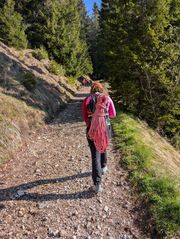
For this route, we recommend parking a bit higher up at Passo Costalunga . Take the trail that starts at the back of the parking lot and after about 10 minutes, at the first fork, turn left and follow the directions to Rifugio Paolina.
The Steep Way GPX
The Pleasant Way
The third option also starts at the Passo Costalunga parking lot, but instead of turning left at the first fork, continue following Trail 548 to the right. Unlike the previous route, which is steep and then evens out, this trail gradually climbs all the way up to Rifugio Roda di Vael. This route also takes about 1 h 30 min, and there is running water about halfway up.
The Gradual Way GPX
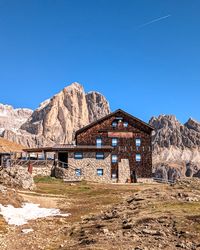
Rifugio Roda di Vael
Rifugio Roda di Vael is usually open from early June to mid-October, depending on winter conditions. It’s a strategic stop on the way to the climbs and via ferratas up on the east sides of Roda del Diavolo, Roda di Vael (Rotwand), and Torre Finestra.
There are 49 beds available during the summer season, and it also has a winter shelter. Although we haven’t stayed there overnight yet, we did get the chance to taste their ricotta-chocolate cake, and we’ll definitely be back just for that.
Getting to Torre Finestra
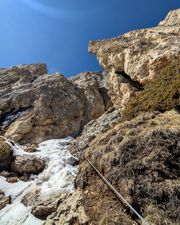
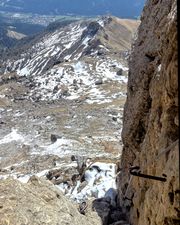
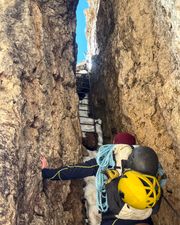
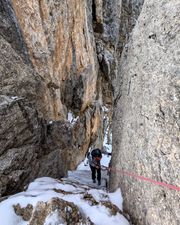
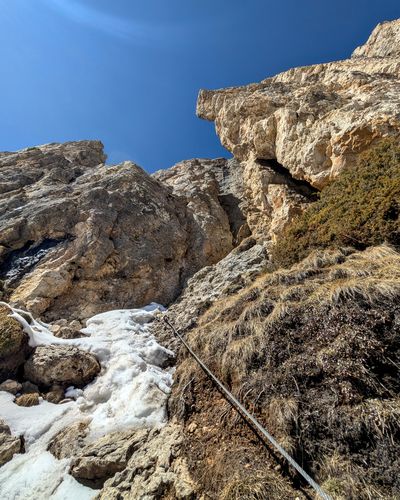
0.8 km 300 m 50 minFrom the hut, it takes just under an hour to get to the base of the climb. There’s only one route, and it involves a short and easy via ferrata section. You don’t need to clip in, but we recommend wearing your helmet, especially if it’s busy. Lot of loose rock on the trail up there.
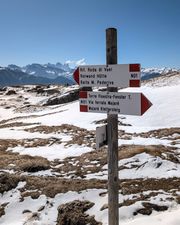
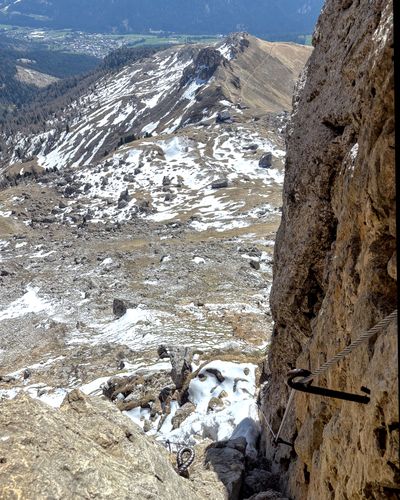
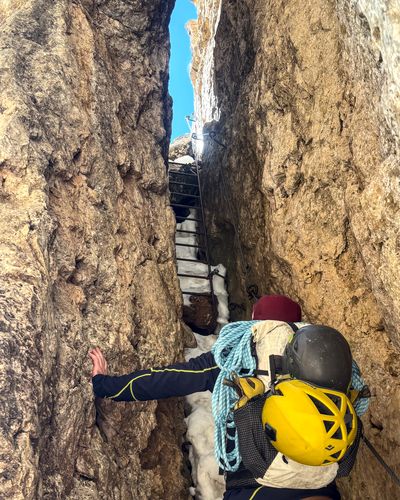
Start by hiking up a short steep section right by the rifugio, after which you cross the plain and arrive at the first fork. From there, follow the marked trail to Torre Finestra and start climbing toward the rock face. After a few switchbacks, you arrive at the first cable section of the via ferrata. There are two of them in total, and the second leads you to the narrow passage equipped with a ladder.
It might require some wiggling, especially if your pack is wide, but it doesn’t take long and you exit the ferrata onto the meadow.
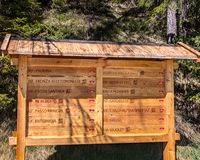
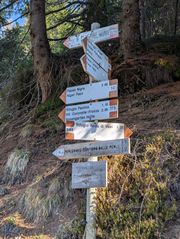
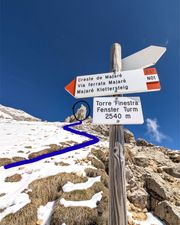
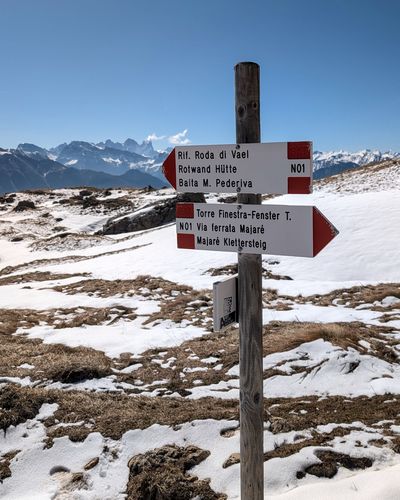
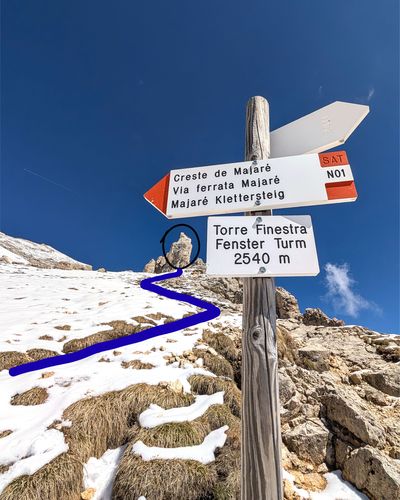
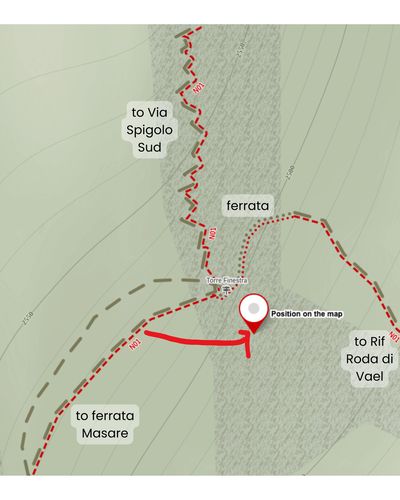
There’s another fork there. The main trail continues to the left to the Masare ferrata, but you turn right and cross the meadow up to Torre Finestra.
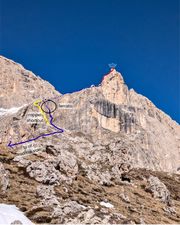
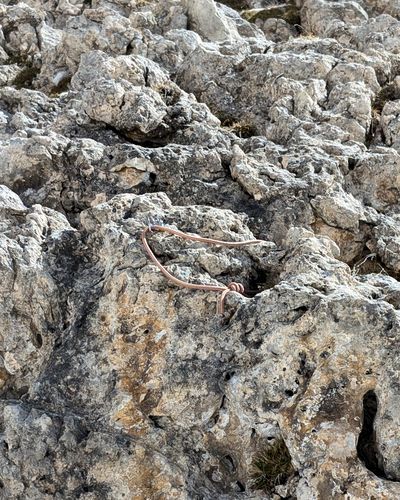
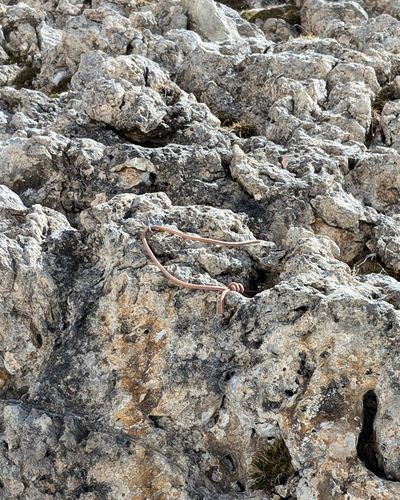
There’s a sling right where the south ridge of the tower meets the trail. That’s where the route starts.
Climbing
Gear & Protection
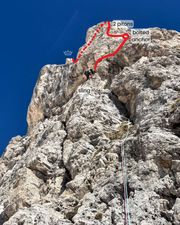
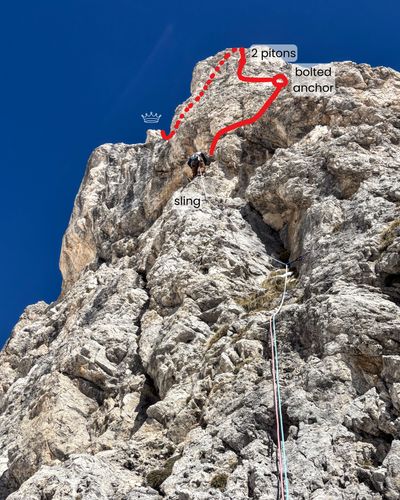
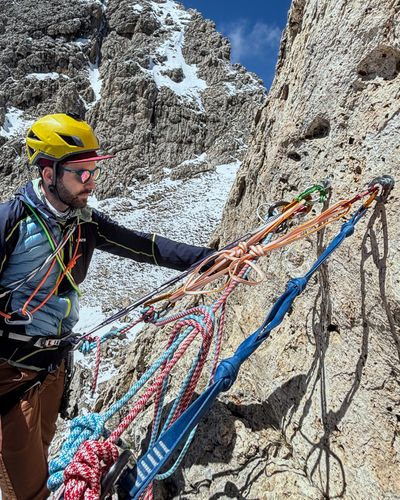
- All the anchors except for the very top are bolted. For the top just bring some long (ideally quad) slings.
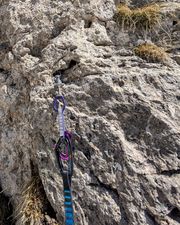
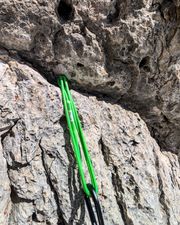
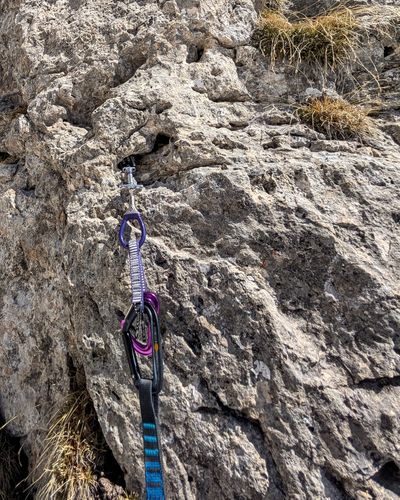
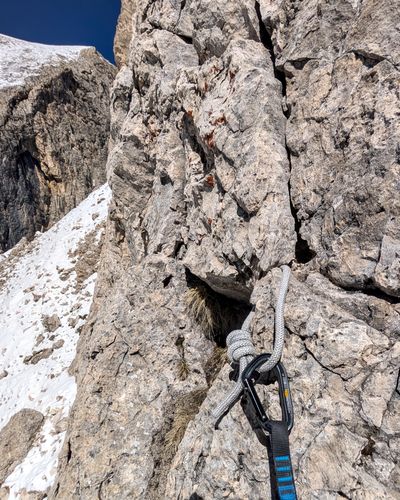
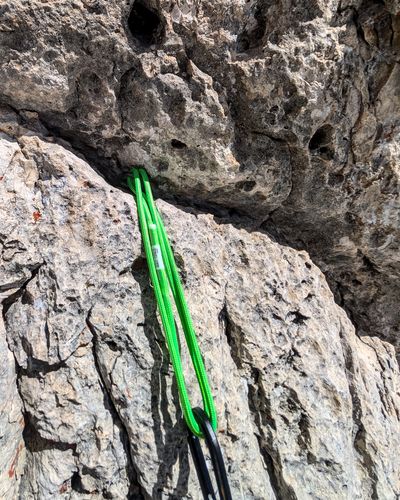
- There are 2 slings on P1
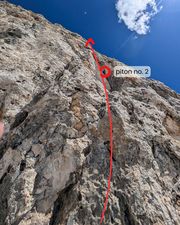
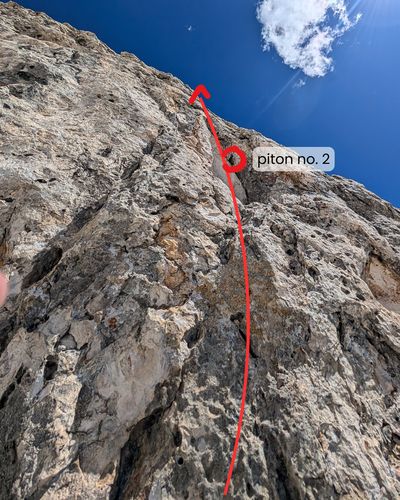
- There are 2 pitons on P2
- There is 1 piton on P3 and another one on P4
- On top of that, we had a few short slings for the pitons and random rock horns, 6 quickdraws, and we placed a few cams between .4 and 2 (but that was mostly just for practice).
- There is a cemented rappel ring at the top, and two 60 m ropes will get you all the way down in one go. Otherwise, it’s two rappels.
Route
P1
The first pitch is very straightforward. Start at the sling by the approach trail. From there, you can see the first belay station above you - two bolts in a yellow rock on a generous ledge.
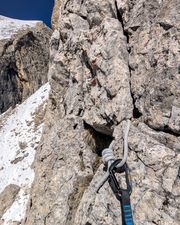
Climb on the left side of a channel going parallel with the ridge. There are plenty of cracks to place gear and eventually you run into a pre-tied sling.
Pass the sling and continue up on the left side of a small niche. Cross to the right above it on good holds. A few moves straight up and you should see the first belay station.
P2
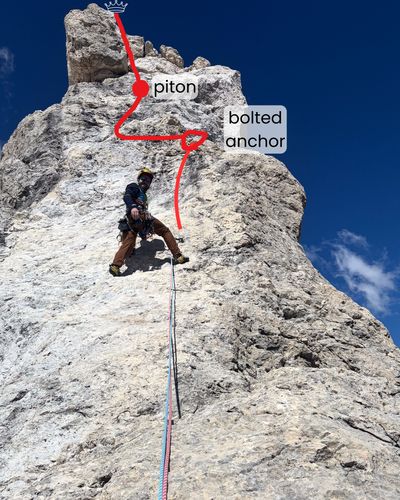
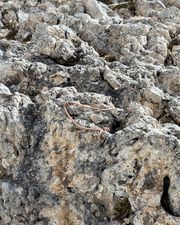
Traverse a few meters to the left of the belay station until you see a piton in a crack above you. There’s one more farther up. Climb that steep section with good holds until the rock flattens out. From there, it’s just a few meters of scrambling to the belay station.
This belay station has clearly been bolted later and it’s not on the original topos. You can skip it but it makes it easier to communicate with your partner since it’s right above the steeper part.
P3
Assuming you stopped at the new belay station, then pitch 3 is just a few meters of very easy climbing on a flat part of the ridge. The next belay station is visible from the get-go, and there’s one piton in the middle.
The pitch ends at a bolted anchor right by a huge hourglass thread. YOu can find that one on the topos, and it used to be the original anchor.
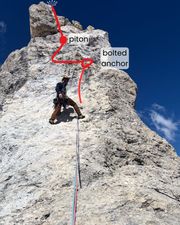
P4
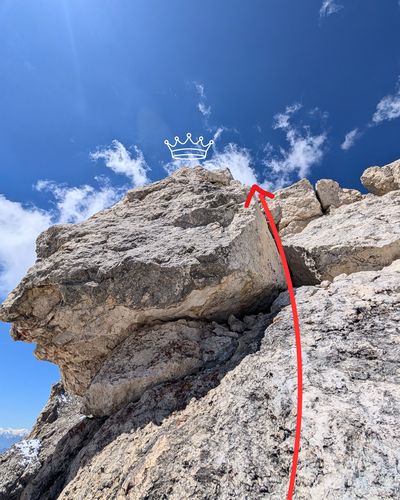
The last pitch used to be the second spicy part of the climb, but it got significantly easier after the recent rockfall.
Go straight up to a visible piton just below the summit block. From there, climb the easy dihedral crack on the right side of the block. There is a sling on the face of the block, but there is also a big, unstable-looking chunk of rock right above it, so we decided to ignore it and stayed in the crack.
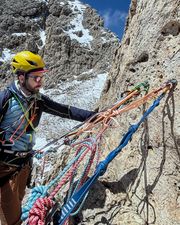
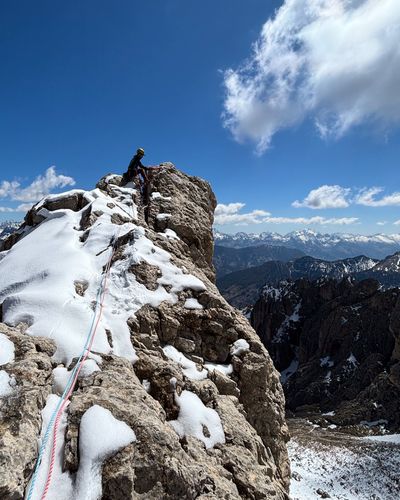
We couldn’t find any bolts at the top, so we made an anchor from a quad sling over the rock horn, backed by a cam.
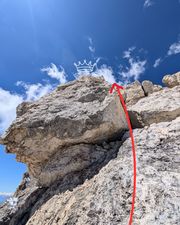
Descent & Return
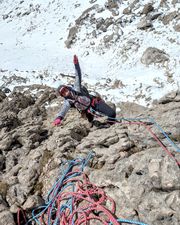
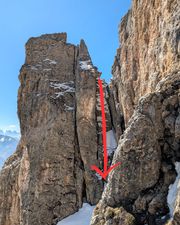
From the top you’ll see a cemented ring just a few meters farther along the ridge. Use it to rappel down on the west (left) side of the ridge. A few meters below the ridge, it goes right over the window with the cross. Pretty neat.
Two 60 m ropes will get you comfortably all the way down to the meadow in one go. From there, follow the obvious trail down, and in a few minutes you’re back at the base of the climb.
The Rappel Shortcut
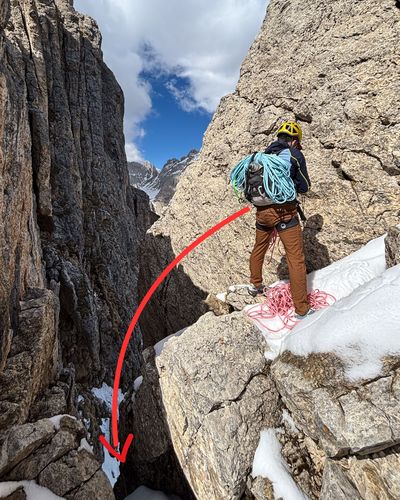
From the base of the climb, take the same trail back to Rifugio Roda di Vael. The first option is to downclimb the via ferrata. It can get really busy in the summer, but luckily you can bypass it with one extra quick rappel.
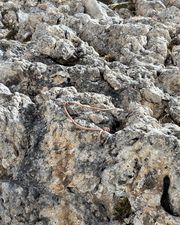
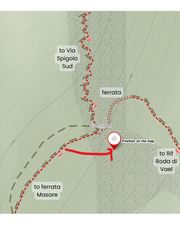
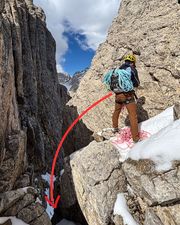
To do so, hike back to the signpost and instead of going left to the top of the ladder, take the trail going right to the Masare ferrata. After about 20 meters, there is a smaller trail going down and left (east). The trail goes below and around some rocks and ends at the top of a wide channel. At the top, on the flat face, there is a rappel ring. It should be right here . A single 60 m rope gets you all the way down just below the first cable section of the via ferrata.
From there, hike down to Rifugio Roda di Vael and take whichever trail you fancy back to Carezza.
Huts & Rifugios
- Rifugio Roda di Vael is the obvious stop either on your way there, back, or both.
- Rifugio Paolina at the top of the chairlift is another option, and it is open in the summer too.
- We’ve also recently stumbled upon a local bar, Restaurante Camera, by the road at Passo Costalunga. The bartender was extremely friendly, it was open already at the end of April, and they had a killer strudel.
- Another option is Ristorante Hennenstall, a bit lower toward Carezza. They have a nice garden, but it gets pretty busy during the season.
- Finally, there is an authentic Thai restaurant at Hotel Lake & River where we stayed once before. The food was really good there.
Weather & Season
- The route starts at 2,600 m, so it can be significantly colder up there than in the valley.
- Depending on the winter, you can run into snow up there even pretty late into spring. Or you might also get lucky, like us, and be able to do it already in late April. Check recent satellite images if you want to be sure.
- The approach, and the route itself, have mostly south, west, and east exposure, so it should get sun most of the day.
Guidebooks & Sources
-
There’s a good amount of info, including the topo, on the Rifugio Roda di Vael website.
-
The route is also on theCrag , although the description there is rather sparse.
-
The route is also in the La Nuova Guida del Catinaccio guidebook from Antonio Bernard. The guidebook has a detailed topo, including a potential extension from the bottom of the via ferrata.
There are two things worth mentioning regarding the info you can find online:
- There was a rock fall that made the last pitch significantly easier. Now you basically just walk up the slab and then climb an easy crack to the top.
- All the belay stations except for the top are now bolted. At the top you still have to use a long sling to make an anchor over the rock horn.